My niece turns twelve at the end of this month, and she wants to join the family chat.
That’s it. That’s what finally did it. I’d been considering this move for years — long enough that considering it had become a habit rather than a plan. Then a child asked to be let in, and I found myself looking at the door.
Fourteen people, twelve years
The family is about twenty-four people if you count everyone, which you should. The ones who actually message are thirteen adults, and at the end of the month, a fourteenth who is twelve.
We’ve been on Slack for twelve years.
I want to be careful here, because this is the part people get wrong about stories like this one. Slack didn’t fail us. Slack was the answer.
Before it, we tried everything. iMessage, which quietly excluded anyone who hadn’t bought the right phone — and in a family of this size, that’s not a minor inconvenience, that’s a wall through the middle of it. WhatsApp, which at the time had no channels at all, so twenty-odd people shared one undifferentiated room where a conversation about a funeral and a conversation about football scores arrived in the same thread, in the same order. Various family-oriented apps, each of which lasted about as long as its funding.
Slack solved all of it. Separate rooms for separate things. Everyone on it, whatever phone they carried. Searchable, quiet, and it stayed out of the way.
People thought we were mad. Using a work tool with your parents? For twelve years I’ve had some version of that conversation. Nobody has it with me anymore, because now everyone’s on Slack and nobody finds it strange. We were just early.
What a family workspace actually is
Twelve years is long enough for a group chat to stop being a group chat.
People arrived. Partners joined, and some of those partners left, which means somebody had to decide what happens to their account and their messages and their place in a family archive they were briefly part of. Children were born and eventually became people who could type. The membership changed, continuously, the way membership does in any small society given enough time.
And somewhere in there I noticed I’d become the person who ran the door.
Not officially. Nobody appointed me. But when someone new joined the family, I was the one who sent the invitation. When someone stopped being family, I was the one who had to think about it. Twelve years of quietly administering a small institution — with none of the authority that should come with it, on premises I didn’t own, holding an archive I couldn’t have taken with me if I’d wanted to.
There’s a rule in there nobody ever wrote down, by the way. You join at twelve. I don’t know when we decided that. I’m not sure we did decide it. But every adult in that workspace knows it, and it’s about to be applied for the first time to someone who was born after we started.
My brother got there first
Earlier this year my brother set up a Matrix workspace and started trying to convince people to move.
He was right, and I want to say that plainly, because he’ll read this. He saw the same thing I saw, and he did something about it while I was still considering.
It half-worked. Some people moved, most didn’t, and the family ended up in the state families end up in — half the conversation in one place, half in another, everyone slightly annoyed.
But there’s a second thing, and it’s the reason I ended up doing this myself rather than just joining his. His workspace lives on matrix.org. That’s the public homeserver — the default, the on-ramp, the place you land when you try Matrix for the first time. It’s a good thing that it exists.
It’s also still someone else’s house.
Moving from Slack to matrix.org gets you a better protocol and the same fundamental arrangement: your family’s conversations sitting on infrastructure belonging to an organisation you’ve never met, under terms you didn’t write, for as long as they feel like hosting it. That’s a real improvement. It isn’t the thing I wanted.
The good news — and this is the part that makes Matrix worth the trouble — is that we don’t have to disagree. Federation means his server and my server talk to each other. He doesn’t have to be wrong for me to be right. His people can stay where they are and still be in the same rooms as mine. That’s not a compromise, it’s the whole design.
What actually changed
Not my principles. I’ve believed roughly this for a decade.
What changed is the effort.
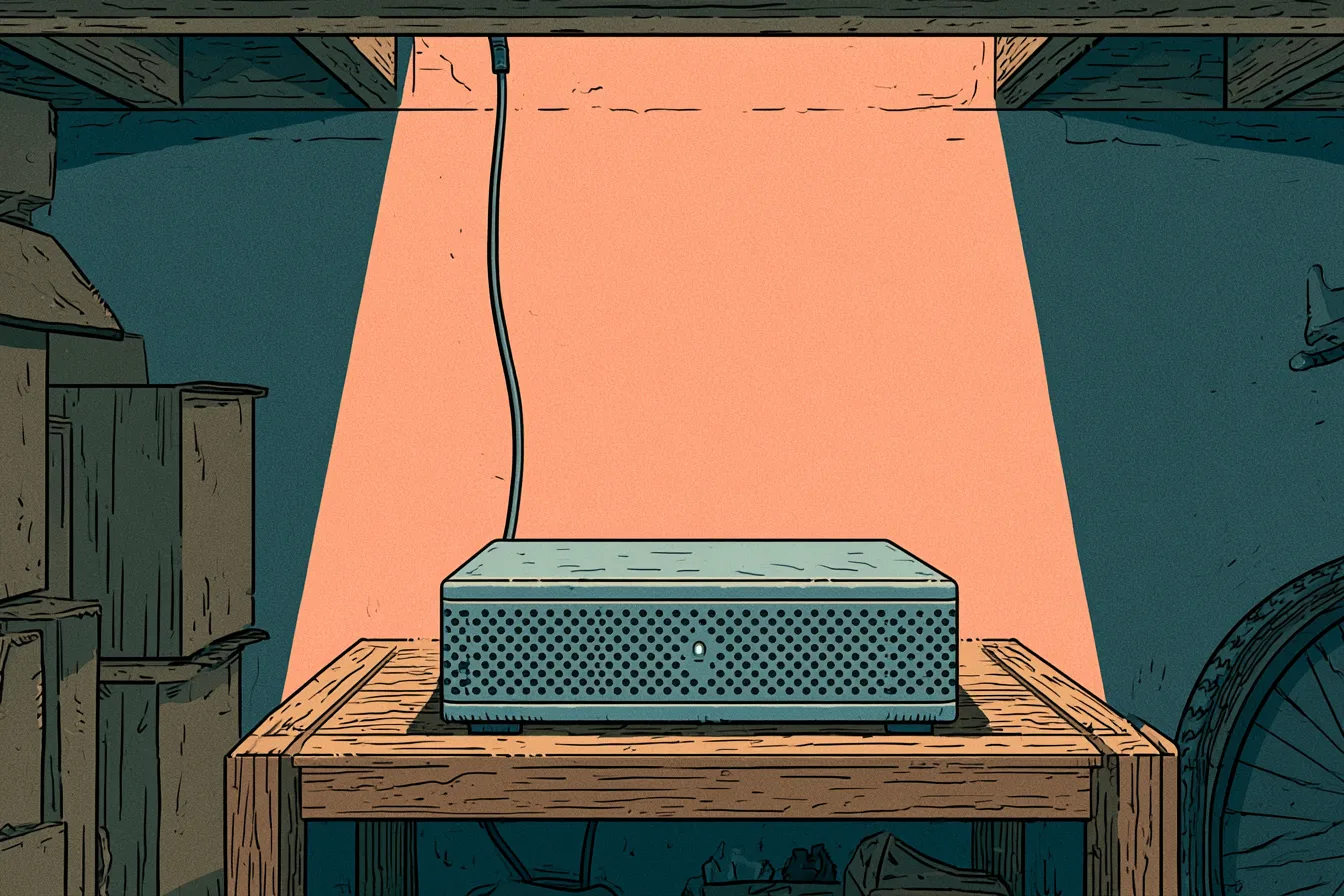
Standing up a Matrix homeserver and an Element web client used to be a systems administrator’s project — a weekend, a wiki page open in another tab, a real chance of giving up halfway. It’s now an evening. Containers, a domain, certificates that renew themselves, and a machine in the basement that was already running anyway.
That’s the whole argument, and it’s not a moral one. For years, self-hosting lost on cost — not money, effort. It was easier to be someone’s product than to run your own server, and honestly, fair enough. But that ratio has been moving for a long time in one direction, and at some point this year it crossed over. Hosting got trivial. Being the product got more expensive.
The result is that my family’s messages now travel from a phone in a kitchen to a machine two floors below me, and nowhere else. No retention policy that isn’t mine. No archive quietly ageing out from under us. No terms that can change in a version I didn’t read.
The part I haven’t finished
I’m writing this from the middle, not the end.
The migration isn’t done. Slack is still running, because thirteen adults don’t move house on a Tuesday. My parents aren’t on Element yet — that’s the next real piece of work, and it’s a genuine one: getting two people who did not grow up with any of this onto a new app on their phones, and making it stick. That’s not a technical problem and I have no illusions about it being easy.
So when my niece joins at the end of the month, she’ll almost certainly land on both. Slack, because that’s where everyone still is. And the family server, because that’s where we’re going.
And I suspect she’s the one who’s going to finish this.
Not because she has any opinion about federation or data sovereignty or who owns which disk. She’s twelve. She’ll use whichever one gets her an answer, and the rest of the family will drift toward wherever she is, because that’s what families do around the youngest person in the room.
Thirteen adults have been considering this migration for years. A twelve-year-old may complete it by accident, in a fortnight, simply by turning up.
She’ll be the first of us to arrive somewhere we actually own. Twelve years of family chat, and this is the first invitation I’ve sent from my own house.
You are not the product anymore.

He runs Wellmade, a product engineering studio, and still writes the code. Twenty years of building products for companies that wanted the thinking and the building done by the same person.
This article was co-written with AI — in the loop from the first draft to the last edit. The argument, the checking and the final word are mine.